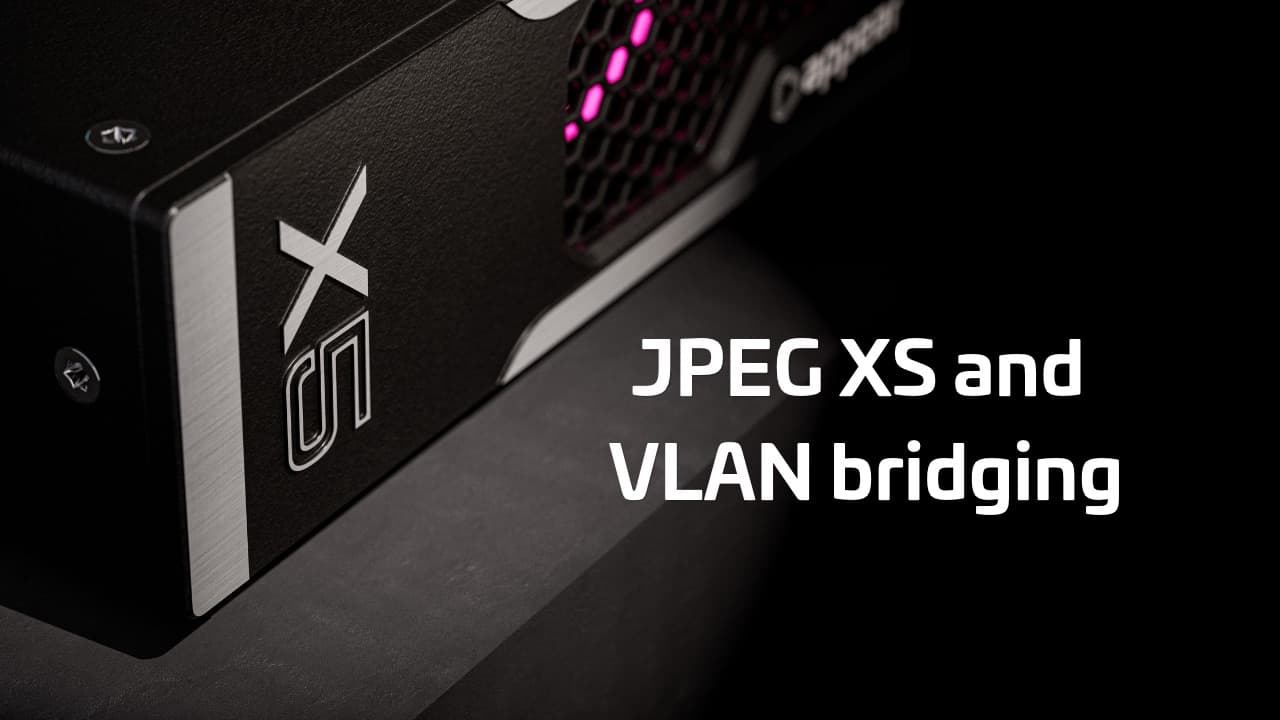
X5 was built to put a full contribution chain in one half-rack unit — combined encode and decode, SDI and IP, a complete audio stack. Two recent additions make that chain more complete: JPEG XS as a full peer codec, and VLAN bridging for deployments that don’t have the luxury of a managed switch on-site.
JPEG XS: a peer codec, not an add-on
X5 now runs JPEG XS alongside AVC and HEVC — not as a bolt-on, but as a fully supported operating image on the same hardware you already deploy. For contribution workflows where latency is the deciding factor, that’s the codec of choice; for everything else, AVC/HEVC remains the default. The trade-off worth planning around: X5 runs one codec family at a time, so the operating image you load determines whether a given unit is doing JPEG XS or AVC/HEVC work that day.
For broadcast engineers specifying contribution infrastructure for live events and remote production, this closes a gap that used to mean carrying a second device, or a different vendor’s box, whenever the spec called for lowest-latency transport. Now it’s the same half-rack unit, the same operator interface, the same signal chain.
VLAN bridging: one less box in the flight case
Live events, fly-away kits and ENG-style deployments share a common problem: the venue network is VLAN-segmented, and the crew needs local access to it — for a laptop, a monitoring tool — without carrying a managed switch to do the segmentation themselves.
X5 now handles this natively. Enable VLAN bridging, and traffic on a configured VLAN ID arriving on the unit’s uplink port is bridged to a dedicated local port, stripped of its tag, and made available to whatever’s plugged in locally. Traffic heading back the other way gets re-tagged automatically. Configuration is optional and off by default, so nothing changes for deployments that don’t need it.
The trade-off is a deliberate one: enabling the bridge repurposes the port normally used for HDMI monitoring. For a lean, fast-moving deployment — exactly the kind this feature targets — that’s the right exchange. For a permanent rack installation where a managed switch and HDMI monitoring are both available, the standard configuration remains the better fit.
X5’s new features at a glance
| Feature | When to use it | Trade-off |
|---|---|---|
| JPEG XS operating image | Latency is the deciding factor for that unit | The unit runs JPEG XS only — not AVC/HEVC — until reloaded |
| AVC/HEVC operating image | Everything else — the default contribution workflow | Not the lowest-latency option available |
| VLAN bridging enabled | Fly-away kits and ENG-style deployments without a managed switch on-site | Repurposes the port normally used for HDMI monitoring |
| Standard configuration (bridging off) | Permanent rack installations with a managed switch available | Keeps HDMI monitoring on the port instead |
Built for how X5 actually gets deployed
Neither of these features exists in isolation. X5’s whole premise is doing more in one unit, in the field, under live conditions. JPEG XS extends what that unit can encode and decode; VLAN bridging extends what it can do on the network it lands in — without adding a second box to the kit list either way.
Rules of thumb for X5’s new features
- Load the JPEG XS operating image only when latency is the deciding factor for that unit, that day.
- Default to AVC/HEVC for everything else — it remains X5’s default codec family.
- Enable VLAN bridging for fly-away and ENG-style kits without a managed switch on-site.
- Leave VLAN bridging off for permanent rack installs where a managed switch and HDMI monitoring are both available.
Get the brief
One REMI workflow, every event. A solution brief for broadcast and media teams building remote production at scale.
Inside the brief:
- Low-latency contribution across managed and unmanaged networks
- Building resilience into remote production workflows
- Reducing on-site infrastructure per event
Complete the form to download.
How to deliver low-latency, resilient contribution across managed and unmanaged networks—while reducing on-site infrastructure.
Download the brief