
Technical Article
Media gateway in IP broadcast workflows: protocol bridging, SDI/IP ingest and sizing for scale
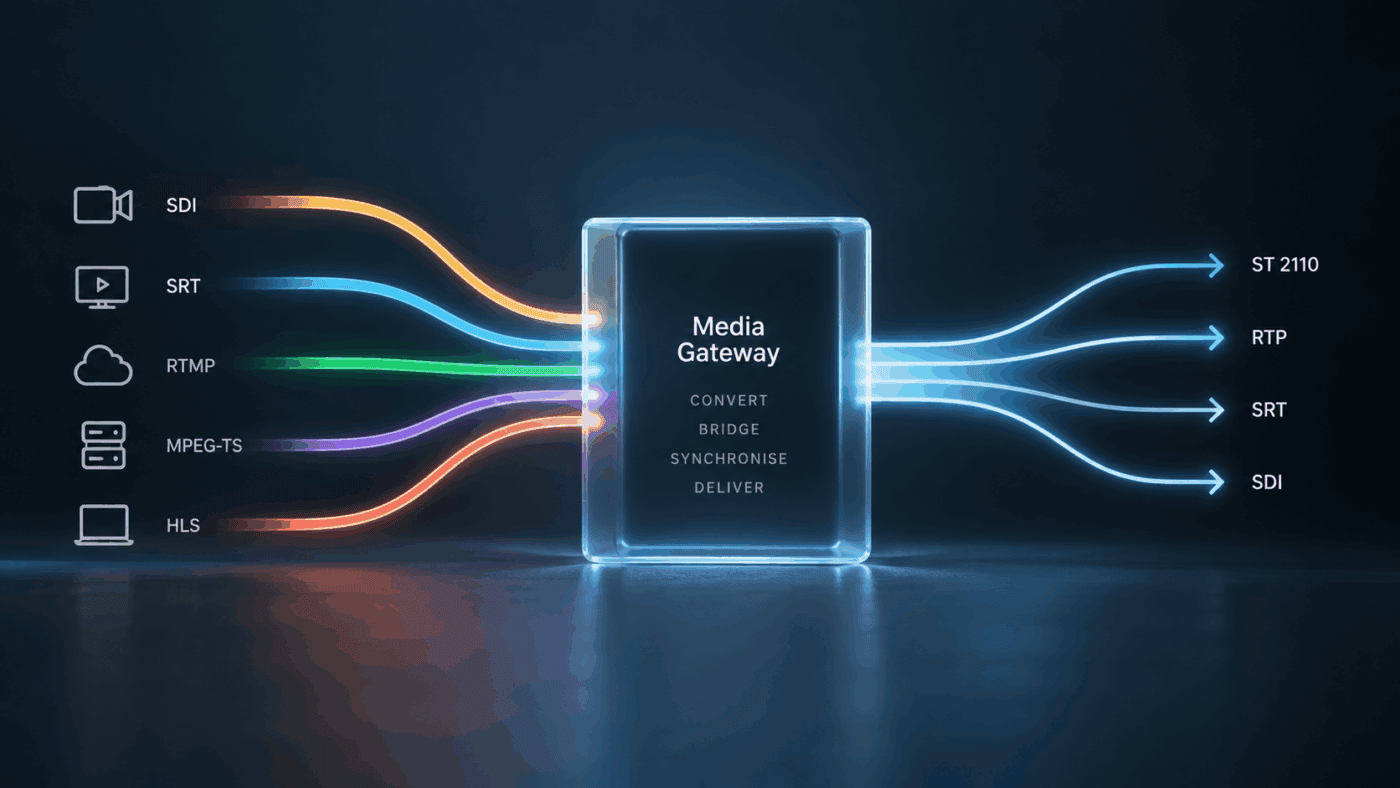
A media gateway is a networked device or software function that bridges different broadcast signal domains — converting video, audio, timing and metadata across physical interfaces and streaming protocols while preserving timing integrity, lip-sync and service continuity for live production. In practice, a gateway might translate between SDI and ST 2110, bridge SRT or RTMP into RTP, or normalise codec formats at ingest — all in real time. As broadcasters navigate hybrid SDI/IP environments and increasingly distributed production models, the media gateway has become the interoperability layer that determines achievable latency, signal fidelity, operational density and resilience. This article covers how media gateways work, their key design trade-offs, sizing considerations for scale, and the standards ecosystem they depend on.
How it works
A media gateway performs three broad classes of operations: interfacing (physical and network I/O), transformation (format, codec and encapsulation conversion), and control/observability (session management, timing reconciliation and telemetry). Each class imposes specific latency, CPU/ASIC/GPU and network requirements that shape gateway architecture and determine where in a workflow it should be deployed. The surrounding network, protocol and timing fundamentals are covered in IP Video Infrastructure for Live Production and Contribution; this article assumes them and focuses on the gateway function itself.
Physical and logical interfaces
On the physical side, gateways present a mix of I/O suited to the domains they bridge. Typical ports include SDI coax (3G, 6G or 12G), Ethernet at 1G, 10G, 25G or 40G, AES or analogue audio I/O, and GPIO for tally and remote control signalling.
The logical protocol landscape is broader. Gateways must handle uncompressed ST 2110 flows (2110-20 for video, 2110-30 for audio, 2110-40 for ancillary data, and 2110-22 for constant-bit-rate compressed video), RTP for compressed contribution per RFC 3550 and its extensions, MPEG transport stream over UDP, SRT for ARQ-protected, encrypted transport, RTMP for legacy ingest, and HLS at distribution edges. Some deployments also require vendor-specific encapsulations.
Interface mapping is where media semantics enter the picture. A gateway maps stream identifiers and encapsulations — for example, the source IP, port, SSRC and RTP payload type of a 2110 flow — to incoming SDI channel identifiers or to SRT/TS session handles. This mapping must preserve frame boundaries and carry through all ancillary data; losing even a single ancillary packet can strip closed captions or SCTE-35 cue messages from a downstream workflow.
Timing, clocking and synchronisation
Timing is arguably the hardest problem a media gateway solves. In ST 2110 workflows, the gateway must present or translate PTP timing (IEEE 1588 PTPv2, using broadcast-specific profiles) to maintain frame-accurate alignment across all essence flows. Depending on the deployment, a gateway can act as a PTP boundary clock, a PTP-aware endpoint, or fall back to a locally disciplined clock when PTP is unavailable.
When translating between packet-based protocols and frame-based SDI, gateways convert between RTP presentation timestamps and SDI frame timing. Best practice is sub-frame or frame-level deterministic delay. Implementations must account for codec group-of-pictures alignment and decoder input buffering to prevent drift over extended programme durations.
Incoming packet jitter is smoothed by adaptive jitter buffers sized for expected network conditions. Buffer depth is a direct trade-off between latency and resilience: typical contribution jitter buffers range from 20 ms on well-managed networks to 500 ms for long-haul or unmanaged paths. Undersizing the buffer risks packet reorder and loss artefacts; oversizing adds latency that may be unacceptable for live production talkback and multi-camera switching. The interaction between buffer depth, round-trip time and retransmission windows is covered in depth in SRT Packet Loss in Live Video Contribution.
Media transformation and metadata
Gateways may operate in passthrough mode — tunnelling compressed RTP without touching the media payload — or perform real-time transcoding between codecs such as HEVC, AVC, JPEG XS or intra-frame formats. Transcode capacity is measured in concurrent channel equivalents; a typical COTS server might handle around eight HD transcodes per CPU socket, with GPU or ASIC acceleration pushing that figure significantly higher.
Encapsulation work is equally important. When bridging SRT or RTP into ST 2110, gateways rewrite RTP headers (SSRC, sequence numbers, timestamps), resegment packets for MTU alignment, and translate payload types — all while maintaining RTP timestamp continuity and correct clock-rate mapping for each media type (90 kHz for video, 48 kHz for audio).
Ancillary data and metadata demand explicit handling. Support for ANC packets, SCTE-35 ad-insertion cues, HDR metadata (static and dynamic), and closed captions (CEA-708/608) must be preserved or regenerated across the protocol boundary. Mapping packetised ancillary data into ST 2110-40 or 2110-41 flows follows SMPTE-defined carriage rules; failure to implement this correctly can result in loss of legally mandated or commercially critical metadata downstream.
Control, session management and observability
Modern gateways expose control planes via REST/HTTP APIs, NMOS IS-04 and IS-05 for registration, discovery and connection management, and vendor CLIs for direct configuration. Control features include flow creation, stream routing, failover configuration and codec parameterisation.
Telemetry is essential for both day-to-day operations and automated scaling. Gateways typically export Prometheus metrics, SNMP traps, and built-in dashboards reporting per-flow packet loss, jitter, CPU/GPU load, bit-rate and PTP offsets. These observable metrics feed runbook automation and orchestration-layer health checks.
Security and network traversal round out the control surface. SRT and DTLS/SRTP provide encrypted transport. Gateways often include NAT traversal support via STUN/TURN, firewall-friendly port management and access-control lists. For contribution from unmanaged networks, FEC configuration and ARQ sizing are common operational parameters that must be tuned per link.
Why it matters in broadcast
Media gateways matter because they sit at the intersection of every major operational concern in live broadcast IP infrastructure.
Interoperability enablement. Gateways let legacy SDI devices and contemporary IP workflows coexist, enabling incremental migration to ST 2110 and cloud-based processing without forklift upgrades. A facility can adopt IP in stages, converting SDI at the boundary rather than replacing every device simultaneously.
Latency and quality control. Gateway design determines the minimum achievable contribution latency and the fidelity of timing and ancillary data — both critical for REMI/remote production and multi-camera synchronisation where even a few frames of misalignment are visible on-air.
Operational footprint and cost. Gateway choice affects rack density, power consumption and OPEX (licensing, observability, maintenance). These factors compound in distributed deployments across remote sites, OB vans and cloud regions where egress costs also apply.
Resilience and continuity. Gateways implement protection behaviours such as A/B failover, ST 2022-7 seamless protection switching and multiple redundant ingest streams. The gateway’s protection capability directly determines on-air continuity during network impairments.
Orchestration boundary. Gateways are the practical point where orchestration and telemetry connect to media. Their APIs and metrics allow automated provisioning, health checks and scale-out — making them the operational building block for software-defined broadcast infrastructure.
Technical specifications and trade-offs
Several design dimensions determine gateway behaviour and suitability for a given workflow.
Throughput is measured as aggregated bit-rate handled per network interface. An uncompressed 1080p50/59.94 ST 2110-20 stream requires approximately 1.5 Gbit/s (video plus audio plus ancillary). Compressed HEVC contribution streams typically range from 4–20 Mbit/s per HD stream depending on profile and content complexity.
Channel density varies dramatically between passthrough and transcode modes. A commodity server running software SRT may handle hundreds of transport-stream sessions when performing only packet I/O and routing, but only tens of concurrent real-time transcodes without hardware acceleration.
Latency profile is the sum of jitter buffer base (20–500 ms), codec-dependent encode/decode delay (HEVC software encoding typically adds 50–200 ms; hardware ASICs can reduce this to single-digit milliseconds per direction), and packetisation/reassembly overhead.
CPU/GPU/ASIC split defines the flexibility-versus-efficiency trade-off. CPU-heavy implementations are the most flexible but least energy-efficient for transcoding. GPUs and ASICs deliver higher density and lower power per channel for fixed-format transforms.
Comparison of common gateway types
|
Gateway type |
Typical use case |
Channel density |
Latency impact |
Hardware requirements |
|---|---|---|---|---|
|
SDI ↔ ST 2110 I/O appliance (hardware accelerated) |
On-site edge for real-time uncompressed / JPEG XS |
High for uncompressed (many SDI ports mapped to 2110 flows) |
Sub-frame to single-frame delay |
FPGA/ASIC modules, 10/25/40G NICs, PTP boundary clock |
|
Software transport gateway (RTP/SRT/TS routing) |
Cloud or datacentre protocol bridging and routing |
Very high for passthrough (hundreds of connections) |
Low (network jitter buffers dominate) |
Commodity x86 VMs, 10G NICs; limited CPU for per-packet processing |
|
Transcoding gateway (real-time codec conversion) |
Multi-format ingest and format normalisation |
Moderate (tens of HD with CPU; hundreds with GPUs/ASICs) |
Moderate to high depending on codec and acceleration |
Multi-core servers + GPUs or specialised encode/decode ASICs |
|
Edge micro-gateway (venue / OB van) |
Local SDI ingest and secured WAN contribution |
Low to moderate (a few to a dozen channels) |
Low with hardware encode; higher with software encoders |
Small form factor with hardware encoders (H.264/H.265 ASICs) |
Sizing rules of thumb
-
For uncompressed ST 2110 streams, budget approximately 1.5 Gbit/s per 1080p50/59.94 flow on 10G links. Plan NIC aggregation to 25G or 40G as density grows.
-
For HEVC contribution, estimate 4–20 Mbit/s per HD stream. When scaling to thousands of streams, CPU and network I/O become the bottlenecks rather than codec licence limits.
-
For software SRT deployment in cloud, each session performing decryption, FEC/ARQ and monitoring consumes measurable CPU cycles. Baselining in target VM types is mandatory — run stress tests with expected packet-loss rates and FEC settings before committing to production sizing.
Related approaches and standards
-
SMPTE ST 2110 family (2110-10, -20, -21, -22, -30, -31, -40): defines uncompressed and constant-bit-rate compressed professional media over IP, RTP encapsulation, and ancillary data carriage.
-
SMPTE ST 2022-7: seamless protection switching providing high-availability IP stream duplication and instantaneous switch-over on path failure.
-
SRT (Secure Reliable Transport): open-source protocol providing packet-level ARQ, AES encryption and NAT traversal optimised for contribution over unmanaged networks.
-
NMOS (IS-04/IS-05): AMWA specifications for discovery, registration and connection management of networked media devices; gateways typically export NMOS endpoints for orchestration integration.
-
RTP/RTCP (RFC 3550 and payload-mapping RFCs): gateways perform RTP header translation and comply with payload-type signalling and RTCP reporting for stream health.
-
PTP (IEEE 1588): precision timing protocol for frame-accurate synchronisation; gateways may function as PTP boundary clocks or PTP clients depending on the deployment topology.
How Appear addresses this
Appear implements the gateway function in two places: in software with VX, and in hardware on the X Platform.
VX is the software transport gateway. It handles UDP/RTP and MPEG transport stream workflows, SRT with configurable ARQ and AES encryption, and ST 2022-7 seamless protection across dual paths. For the header-rewriting work described above, VX filters inputs by MPEG-TS or RTP, passes RTP headers transparently from source device through to destination, carries RTP headers over SRT links, and can generate internal RTP headers so coherent services can be sent across separate outputs rather than a single ST 2022-7 pair. VX does not currently implement FEC — loss recovery is ARQ over SRT — which should be reflected in per-session sizing.
VX runs on commodity Linux hardware, private-cloud VMs, and public-cloud instances, with the same workflow configuration and software stack in each. Every operation available in the interface is also available through the API, and every workflow step publishes structured metrics continuously to Prometheus and Grafana, alongside live flow views and alarms.
Where the boundary needs hardware — SDI-to-IP conversion, PTP handling, high-density codec processing — the X Platform covers it. X10 in 1RU and X20 in 2RU are modular chassis taking dedicated IP gateway modules alongside encode and decode modules, and X5 is the compact unit for a venue or OB van. VX integrates directly with that hardware, so the performance-critical edge stays in silicon while the transport and routing layer moves to software.
FAQ
What is the primary difference between a gateway and a router in broadcast IP workflows?
A router forwards packets at Layer 2 or Layer 3 without understanding their content. A media gateway understands media semantics — RTP timestamps, ancillary data, codec structures — and performs encapsulation, decapsulation, timing conversion and codec processing required by live production.
Does a gateway always transcode?
No. Gateways may operate in passthrough mode, performing only packet header rewrites and routing, or in processing mode where they transcode, transrate or rewrap media as the workflow demands.
How does a gateway preserve genlock and lip-sync when converting SDI to IP?
By mapping SDI frame timing to PTP or an internal disciplined clock, preserving presentation timestamp values and maintaining audio/video alignment throughout packetisation and buffering.
Where should gateways be placed: edge, core or cloud?
Placement depends on trade-offs. SDI-to-IP and low-latency uncompressed gateways belong at the edge or venue. Transport-only or high-scale routing gateways can sit in the core or cloud to centralise orchestration and reduce on-site complexity.
What are typical latency contributors when using a media gateway?
Encoder/decoder processing, adaptive jitter buffer sizing, packetisation interval, network propagation, and any retransmission scheme (ARQ or FEC). Minimising each element reduces end-to-end latency.
How do gateways handle NAT and firewall traversal for remote contribution?
Gateways typically support SRT with built-in handshake and NAT traversal, STUN/TURN for UDP flows, and port pinning or connection brokering. They also expose firewall configuration recommendations and diagnostics to operators.
How do I estimate gateway capacity for a live sports event?
Benchmark expected stream counts, codecs and bit-rates. For uncompressed 1080p ST 2110, plan approximately 1.5 Gbit/s per stream. For encoded HEVC, estimate per-stream bit-rate and total CPU/GPU needs, then add headroom for protection streams and control-plane overhead.
Can gateways be orchestrated automatically?
Yes. Modern gateways provide REST APIs, NMOS IS-04/IS-05 support and telemetry endpoints that orchestration systems use for automated provisioning, scaling and health checks.
What ancillary data must a broadcast gateway preserve?
Closed captions (CEA-708/608), SCTE-35 ad-insertion cues, HDR metadata, timecode and other ANC payloads. If not preserved, downstream workflows lose legally mandated or commercially valuable metadata.
Are software gateways in the cloud as reliable as appliance gateways?
They can be, when deployed with correct sizing, multi-availability-zone redundancy, managed networking with QoS, and appropriate protection mechanisms such as duplicate streams or ST 2022-7-style redundancy. Operational readiness and observability are the determining factors.
How should I set jitter buffer sizes?
Base the buffer on measured network jitter and worst-case path behaviour. Start with the minimum that maintains acceptable end-to-end delay — typical contribution buffers range from 20 to 500 ms — and increase only if packet loss or reordering requires it.
What monitoring metrics are most important for gateway operations?
Per-flow packet loss, jitter, bit-rate, RTP sequence and clock continuity, PTP offset, CPU/GPU utilisation, memory pressure, and alarms for protection-failover events.
Appear delivers the low-latency contribution, processing and transport behind the world's most demanding live productions.