By Oliver Abadeer, VP Product Marketing
The debate between remote production (REMI) and OB asks the wrong question. Broadcasters do not need to select one production model for every event. They need an operating model that moves people, processing, and risk to the right place for each production.
The answer is a tiered hybrid strategy: use REMI for repeatable, high-volume coverage; retain OB or an on-site fallback for marquee events; and use cloud selectively where elasticity matters. This approach helps teams cover more events without treating every show as either a cost-cutting exercise or a zero-risk final.
Where each production model fits
| Production model | Best suited to | Why it works |
|---|---|---|
| Remote production (REMI) | Repeatable, high-volume coverage | Centralises operators, shrinks venue teams from 30+ people to as few as three to five |
| OB or on-site fallback | Marquee, one-off events, or uncertain connectivity | Often the most economical and resilient option for a single event |
| Cloud (elastic) | Variable or spiking demand | Used selectively, where elasticity genuinely matters, not as a default |
Why is hybrid REMI the right model?
Event value, connectivity, latency, and operational risk change from venue to venue. A regular-season fixture over diverse fibre is not the same engineering problem as a global final at a site with uncertain connectivity.
Remote production can reduce venue teams from more than 30 people to as few as three to five, while centralised operators work across multiple productions. TNT Sports has publicly targeted remote delivery for 80% of its live broadcasts. But neither figure makes remote production the default. For a one-off event, an amortised OB truck may still be the most economical and resilient option.
The better measure is not cost per event. It is the performance of the production portfolio: resource use, events covered, recovery options, and confidence on air.
How do IP and SRT extend remote production?
IP and Secure Reliable Transport (SRT) extend remote production by making more venues, regional sites, and cloud resources reachable over flexible networks. SRT makes public-internet paths suitable for professional live video through packet-loss recovery, configurable latency, and AES encryption.
Appear’s hardware-accelerated SRT removes a previous constraint: scale. An X20 configuration can support up to 72 Gb/s of SRT traffic and 1,536 connections in 2RU, with predictable performance under load. That makes SRT relevant to multi-camera sport, primary distribution, and ground-to-cloud workflows—not just occasional contribution feeds.
Real-world example: Chilevisión recently used hardware-accelerated SRT to carry HEVC video into AWS for live cloud processing and return it for nationwide 4K World Cup delivery. This is IP operating as core broadcast infrastructure, not simply a backup path.
The engineering question is no longer whether IP belongs in mission-critical production, but how each route is protected. Managed fibre, public internet, private 5G, cellular, and LEO satellite can work as primary or diverse backup paths. Redundancy, real-time monitoring, and measured latency remain essential, particularly for camera control, commentary, and return monitoring.
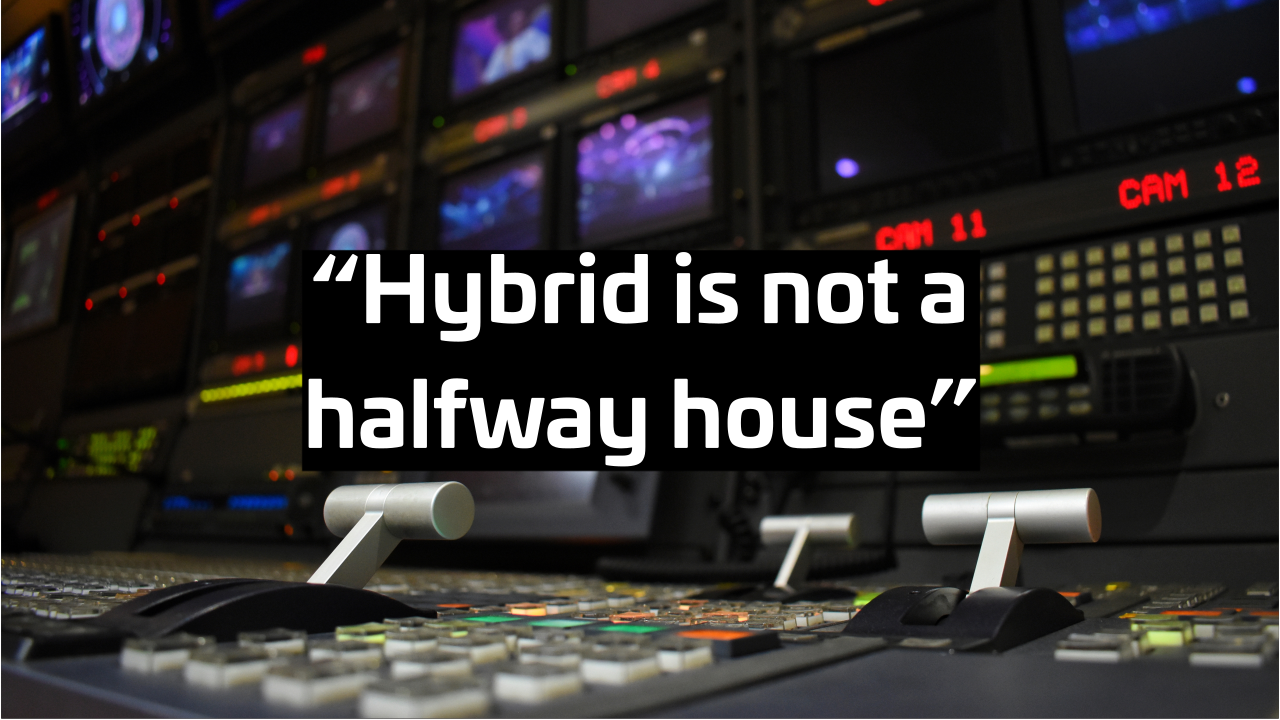
Hybrid is not a halfway house
Hybrid production is often described as a compromise. We see it as control: keep latency-sensitive functions at the venue, centralise repeatable functions, and retain an OB or shadow workflow when the consequence of link failure is unacceptable.
This also changes the investment logic. Build a central hub for sustained event volume, not because remote production is fashionable. Preserve local capability where it removes material risk, not because that is how production has always been done. Make the boundary movable as connectivity, crew availability, and event value change.
Common misconceptions about hybrid production
Myth: hybrid production is a compromise, a halfway house between REMI and OB.
Fact: hybrid is control — keeping latency-sensitive functions at the venue, centralising repeatable functions, and retaining an OB or shadow workflow when the consequence of link failure is unacceptable.
Myth: REMI should be the default for every event.
Fact: for a one-off event, an amortised OB truck may still be the most economical and resilient option. The right measure is the performance of the whole production portfolio, not cost per event.
Myth: IP is just a backup path for when the primary connection fails.
Fact: hardware-accelerated SRT already operates as core broadcast infrastructure — Chilevisión used it to deliver nationwide 4K World Cup coverage, not as a contingency plan.
What should broadcasters do now?
Start with four decisions:
- Classify event tiers by audience value and tolerance for failure.
- Define measured limits for latency, bandwidth, and recovery time.
- Prove diverse transport and failover before reducing the on-site footprint.
- Train teams across broadcast and IP operations so the model works under pressure.
Our position is simple: REMI should earn its place through repeatability, OB through risk reduction, and cloud through genuine elasticity. The strongest live production strategy uses all three deliberately.
The future is not REMI instead of on site. It is production architecture that places each function where it performs best. That gives broadcasters more coverage, better use of scarce talent, and resilience matched to the event—not the ideology.
Get the brief
One REMI workflow, every event. A solution brief for broadcast and media teams building remote production at scale.
Inside the brief:
- Low-latency contribution across managed and unmanaged networks
- Building resilience into remote production workflows
- Reducing on-site infrastructure per event
Complete the form to download.
How to deliver low-latency, resilient contribution across managed and unmanaged networks—while reducing on-site infrastructure.
Download the brief