

By Ivan Geraghty, Solutions Engineering Manager.
Why test remote production without fixed connectivity?
Live production keeps finding its way into venues that were never built for it: fields, car parks, temporary structures at festivals, pop-up studios a long way from the nearest fibre run. If there’s no dark fibre, no managed Ethernet, and no reliable broadband at the site, the contribution link must be built from whatever wireless capacity is available on the day. That usually means cellular. Increasingly, it also means satellite, in this case a low-Earth-orbit (LEO) network.
Bonded cellular is not new to broadcast contribution, but it has traditionally meant a purpose-built appliance with proprietary bonding logic built in. This test explored what happens when that is decoupled: running an open, third-party bonding layer (aggregating multiple 5G carriers and a LEO connection into a single tunnel) underneath standards-based broadcast transport (SRT) on the Appear X5. Would the two layers cooperate, or would they get in each other’s way at the point where it matters most, an active broadcast feed?
Two field sessions, on location and under real weather, provided the answer.
The test setup
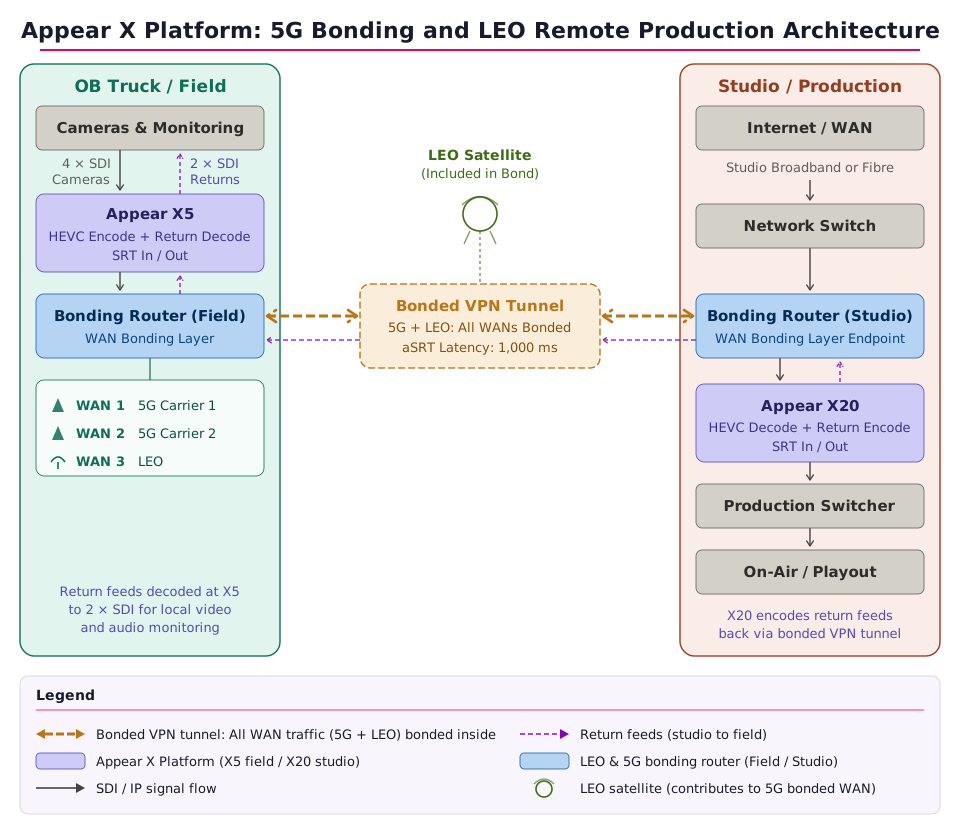
At the field end, an Appear X5, a compact, half-rack, portable chassis, ingested SDI camera feeds and encoded them to HD Low Latency HEVC at 6 Mbps, sending them out as SRT streams over hardware-accelerated SRT. A bonding device in the field took it from there, aggregating the available WAN links (two 5G carriers plus a LEO connection) into a single bonded tunnel. As far as the X5 was concerned, that tunnel was just an IP connection. It had no visibility into how many links sat underneath it or which one any given packet travelled over.
At the studio end, a second bonded device received the bonded WAN tunnel and terminated it, handing off standard SRT streams to the equipment behind it. Unlike the field unit, the studio-side device did not need its own 5G or LEO connectivity: it received the bonded 5G stream directly over the studio’s regular internet connection. Once terminated, the SRT streams could be picked up by an Appear X20, or in principle by any other SRT-capable device. The X20 decoded the four contribution feeds to SDI for the production switcher while simultaneously encoding two return feeds and sending them back to the truck over the same bonded tunnel. It’s also worth noting that enabling SRT can add up to 25% to the bandwidth requirement of each stream, that overhead needs to be planned for when sizing a bonded WAN connection.
Configuring the bonding devices mattered as much as connecting them. Within the WAN link, the 5G carriers and the LEO connection were given the same priority setting, so every network was treated as a first-class citizen within the bond rather than held back as a fallback. Weighted traffic distribution was also enabled, spreading traffic across the active links in proportion to their real-time performance.
| Metric | Result |
|---|---|
| Simultaneous SRT streams | 6 (4 contribution + 2 return) |
| End-to-end latency | 1,000ms through adverse weather; tunable lower in stable conditions |
| Packet loss | 0.00% in standard conditions; 202 of 4.7 million packets lost (approximately 0.004%) during a severe weather event |
| Audio | Primary programme audio plus an additional embedded PCM pair for talkback, carried in both the contribution and return SDI feeds, enabling two-way communication between field and studio |
Those are the headline results. What follows is what the proof-of-concept testing revealed.
Bandwidth doubles when retransmission logic is doubled
During pre-live testing, ahead of both sessions going to air, the streams began showing visible video breakup and glitches, a sharp rise in SRT retransmission requests, and CC (continuity counter) errors across every stream. The network graphs showed total bandwidth consumption had roughly doubled, to around 90 Mbps for a stream count that should have used less than half that. This pointed toward a smoothing feature on the bonding device’s WAN configuration. Turning that smoothing feature off resolved the issue: overall bitrate dropped back into the expected range, CC errors stopped, and SRT retransmission requests fell to a fraction of what they had been.
The cause was two systems doing the same job at different layers. The bonding device’s smoothing feature is designed to even out jitter and loss across bonded links before handing traffic to the application above it. Appear’s hardware-accelerated SRT already handles its own retransmission and jitter recovery as part of the SRT protocol. With both active, the bonding layer and the transport layer were each independently requesting retransmission for the same lost data, duplicating recovery work and the bandwidth it consumed. Disabling the smoothing feature on the bonding device and leaving hardware-accelerated SRT in place brought total bandwidth down to roughly 46 Mbps, about half, with no loss of stream stability.
Neither system was misbehaving. Each was doing exactly what it was designed to do. It’s a useful lesson: stacking an intelligent transport protocol on top of an intelligent bonding layer can deliver unexpected results.
How the link held up when the weather turned
The general rule of thumb for setting SRT latency is 4 to 5 times the round-trip time of the slowest active link, which is why measuring RTT separately across each network path matters rather than assuming a shared figure. In testing, the 5G links consistently showed much lower RTT than the LEO connection, and that gap widened further in bad weather.
The LEO link’s round-trip time held a steady 60 to 80ms baseline in clear conditions. Under heavy rain, high wind, and thick cloud cover during one of the sessions, that spiked intermittently to between 150 and 291ms. At an SRT latency setting of 800ms, that spike was tight enough to cause occasional retransmission requests to arrive too late to be useful, and some packets simply couldn’t be recovered in time. Moving the SRT latency buffer up to 1,000ms restored stability for the rest of the test.
To manage the LEO link directly, a latency threshold setting was also configured on the bonding device: once the LEO link’s RTT rose above 150ms it was excluded from the active bond for a 2,000ms hold-off period, then rejoined once the latency dropped back below the threshold. This proved effective at steering traffic away from the LEO link during the RTT spikes caused by adverse weather, and helped keep the remaining streams stable at the 1,000ms latency setting.
The overall resilience performance for that session, across roughly 4.7 million packets sent during a severe weather event, saw 202 packets dropped and not recovered, approximately 0.004% of the total, with the system continuing to operate in challenging conditions with no reports of any degradation to the video being received.
A couple of smaller things worth knowing
- External antennas outperform integrated ones. Swapping compact built-in antennas for roof-mounted directional or omnidirectional external antennas make a measurable difference to cellular throughput, particularly at sites with weaker tower coverage.
- Coverage isn’t evenly distributed. Even between two carriers at the same site, throughput contribution varied significantly, and it varied again between venues. Multi-operator SIM diversity, combined with LEO, rather than reliance on a single carrier, is what delivers resilience in practice.
What could this enable?
A lot of broadcasters share the same underlying problem: how to get a broadcast-grade contribution and return signal out of a venue with no fixed connectivity at all, without committing to a single vendor’s closed encoding and bonding appliance.
Running video contribution over an independent bonding layer means the broadcast transport and the network layer beneath it can each be chosen, configured, and upgraded on their own terms. It does still require a bonding device at both ends of the link, terminating the bonded 5G connection and presenting a plain IP connection to the equipment, the same way the field-side device presented a plain IP connection to the X5. That IP connection can carry SRT, FEC-protected video, or any other IP-based transport, with no proprietary gateway required beyond the bonding hardware itself. That matters most for venues with genuinely no fixed connectivity option: a temporary outdoor site, a remote regional venue, or a location where running fibre simply isn’t practical. In those cases, the combination of full SDI return feeds, embedded talkback audio, and open-standards transport is a useful pattern to have validated in the field.
Common misconceptions about bonded wireless contribution
Myth: bonded cellular contribution requires a purpose-built, closed appliance.
Fact: this test decoupled the two layers entirely, running an open, third-party bonding layer underneath standards-based SRT transport on the Appear X5, with no proprietary gateway required beyond the bonding hardware itself.
Myth: stacking more retransmission and recovery layers always makes a stream more resilient.
Fact: running the bonding layer’s smoothing feature alongside hardware-accelerated SRT’s own retransmission roughly doubled bandwidth use. Disabling one halved it again, with no loss of stability.
Myth: these results are a certified deployment blueprint anyone can copy.
Fact: this was exploratory, field-based testing rather than a fixed deployment blueprint. The numbers reflect the conditions tested, and will vary by venue, carrier, and weather.
Three rules of thumb from the field
- Tune SRT latency to the worst-case round-trip time observed at the venue.
- Check whether the WAN bonding layer and the transport protocol are both handling retransmission; if so, disable one.
- Run a WAN speed test at the venue before committing to a stream count or bitrate, since cellular performance varies by time of day as much as by location.
This was exploratory, field-based testing rather than a fixed deployment blueprint, and the numbers reflect the conditions tested rather than a guarantee for every site. It remains a solid data point for anyone thinking through how to get a broadcast-grade signal in and out of a venue with no fixed connectivity to lean on.
Get the brief
One REMI workflow, every event. A solution brief for broadcast and media teams building remote production at scale.
Inside the brief:
- Low-latency contribution across managed and unmanaged networks
- Building resilience into remote production workflows
- Reducing on-site infrastructure per event
Complete the form to download.
How to deliver low-latency, resilient contribution across managed and unmanaged networks—while reducing on-site infrastructure.
Download the brief