Technical Article
Broadcast Network Modernization for IP- and Cloud-Based Live Production
Broadcast network modernization is the technical and operational transition from legacy baseband and satellite-centric architectures—built around SDI routing and DVB-S/S2 distribution—to IP- and cloud-native media transport, processing, and control. The scope of this transition encompasses migration to packetized professional media (SMPTE ST 2110 and related standards), adoption of low-latency compressed transport protocols such as SRT, HEVC, and JPEG XS, deployment of orchestration and monitoring frameworks (NMOS, PTP, estate management), and the design of hybrid edge–core–cloud topologies that balance quality, latency, cost, and resilience. This article provides a technical reference for the building blocks, trade-offs, standards, and architectural patterns that define modern broadcast infrastructure.

How It Works
The following sections summarize the core technical building blocks and how they combine to deliver modern broadcast networks.
Packetized Professional Media (ST 2110 and RTP Streams)
SMPTE ST 2110 is the foundational standard suite for professional media over managed IP networks. Unlike SDI, which carries all signal essences on a single serial link, ST 2110 splits video, audio, and ancillary data into separate RTP streams routed independently over IP. This separation enables granular routing, independent timing, and per-essence processing—capabilities that are impossible with monolithic baseband transport.
The key sub-standards define how each media type is carried:
-
ST 2110-20 specifies uncompressed or constant-bit-rate compressed video over RTP.
-
ST 2110-30 (aligned with AES67) handles audio.
-
ST 2110-40 carries ancillary data such as closed captions and timecode.
Timing and frame alignment across these independent streams rely on PTP (IEEE 1588), profiled for broadcast use by SMPTE ST 2059. Without precise PTP distribution, multi-essence synchronization breaks down.
Network infrastructure must be sized for worst-case uncompressed payloads or for planned compressed profiles. Traffic shaping per ST 2110-21 governs packet burst behavior and buffer sizing, ensuring that media flows do not overwhelm switch fabric or introduce unacceptable jitter.
Low-Latency Compressed Contribution (SRT, HEVC, JPEG XS)
Where ST 2110 excels on managed campus and facility networks, compressed contribution protocols address the challenge of transporting broadcast-quality media over wide-area and unmanaged networks. These protocols combine lightweight or visually lossless codecs with ARQ-based error recovery, forward error correction, connection bonding, and AES encryption.
SRT (Secure Reliable Transport) provides connection management and AES-256 encryption with sub-second end-to-end latency when paired with HEVC encoding. JPEG XS targets sub-frame latency with visually lossless compression ratios, making it well-suited for multi-camera REMI (Remote Integration Model) workflows where every millisecond of delay affects production timing.
Typical deployment patterns follow a clear logic: compressed contribution is used for WAN and cloud links or when bandwidth is constrained, while uncompressed ST 2110 is reserved for managed campus or core networks and for the most critical live signal paths. This division allows organizations to optimize cost and performance simultaneously rather than over-provisioning bandwidth end to end.
Edge–Core–Cloud Topology and Orchestration
Modern broadcast networks are not monolithic. They are distributed across three logical tiers, each with distinct processing roles and hardware profiles.
Edge deployments sit at venues, stadiums, or flypack locations. Compact encoders, SDI/IP gateways, and local transcoders handle capture and initial transport. The edge is where baseband signals from cameras and audio consoles are ingested and packetized for onward delivery.
Core infrastructure typically resides at a broadcaster’s primary facility or data center. High-density chassis and media gateways aggregate incoming feeds, perform de-multiplexing, multiplexing, transcoding, and security termination. The core is the operational hub where production switching, monitoring, and quality control occur.
Cloud and virtual processing provides elastic capacity for tasks such as graphics rendering, playout, distribution encoding, or handling peak demand during major events. Hybrid deployments are the norm: on-premises hardware handles always-on, latency-critical paths while cloud resources absorb burst workloads or serve distribution tiers.
Orchestration ties these tiers together. NMOS IS-04 and IS-05 provide discovery and connection management for IP media devices. Estate management platforms expose Prometheus-compatible metrics and centralized APIs for lifecycle management and operational visibility. PTP synchronization extends across distributed nodes to maintain timing coherence from edge to core.
Security, Resilience, and Transport Protection
IP-based broadcast networks expand the attack surface compared to isolated baseband systems. A robust security stack includes encrypted transport (AES-256 or equivalent) on all contribution and distribution links, identity and access controls at edge gateways, and secure key management for content distribution workflows.
Resilience in IP broadcast networks is achieved through multiple complementary mechanisms. ST 2022-7 seamless protection switching provides hitless failover by sending duplicate streams over diverse network paths. SRT’s built-in ARQ and multi-path WAN bonding offer resilience over unmanaged networks. IP-FEC (forward error correction) adds a further layer of protection on lossy links, recovering lost packets without retransmission delay. Together, these mechanisms can deliver availability levels that match or exceed those of legacy satellite and microwave contribution paths.
Why It Matters in Broadcast
The shift to IP- and cloud-based architectures is not a technology exercise for its own sake. It addresses concrete operational and economic pressures facing broadcasters.
Operational scaling is perhaps the most immediate driver. IP-based remote production (REMI) allows centralized production across multiple simultaneous events without proportional increases in outside broadcast vehicles or on-site staff. A single production center can switch between venues, scaling personnel and processing resources dynamically.
Cost and sustainability gains come from consolidating RF and satellite stacks, reducing rack space, and lowering watts-per-stream when hardware is optimized for density and compression. Modern media processing platforms can handle more channels per rack unit while consuming less power than the equipment they replace.
Faster time to market results from API-driven control, NMOS-based discovery, and cloud elasticity. Launching a new channel, adding a feed, or reconfiguring a contribution path can be accomplished in software rather than through physical rewiring, reducing provisioning time from days to minutes.
Future flexibility is inherent in standards-based IP architectures. Because ST 2110, NMOS, and open transport protocols like SRT are vendor-neutral, broadcasters can mix components from multiple manufacturers and migrate incrementally rather than undertaking costly forklift replacements.
Technical Specifications and Trade-Offs
Engineering and procurement decisions in broadcast network modernization require careful evaluation of several interrelated dimensions.
Principal Trade-Off Dimensions
Latency varies dramatically across transport methods. Uncompressed ST 2110 on managed networks delivers sub-frame to single-frame latency. JPEG XS can approach sub-frame latency with compression. HEVC over SRT typically targets tens to hundreds of milliseconds depending on bonding configuration, FEC overhead, and underlying network quality.
Bandwidth is a primary constraint. Uncompressed 1080p60 at 10-bit YUV 4:2:2 requires on the order of 2.5 Gb/s per stream. HEVC and JPEG XS can reduce this by an order of magnitude or more depending on codec settings, though at the cost of some compression latency or, in HEVC’s case, generational quality loss.
Synchronization requirements differ by use case. ST 2110 with PTP supports sample-accurate multi-essence synchronization suitable for live switching. Compressed WAN flows require timestamping and alignment logic at ingest to integrate into centralized production mixes, adding complexity.
Infrastructure cost presents a classic trade-off. Unmanaged public internet with SRT offers low capital expenditure but introduces higher operational variability and potential SLA risk. Dedicated IP/MPLS or private wavelengths raise capital costs but significantly reduce jitter and packet loss risk for mission-critical feeds.
Comparison Table: Named Alternatives and Concrete Dimensions
|
Alternative |
Typical Use Case |
Latency (Typical) |
Bandwidth per 1080p60 Stream |
Synchronization |
Resilience Mechanisms |
|---|---|---|---|---|---|
|
SDI (coax) |
Local signal paths, OB truck I/O |
Sub-frame (native) |
N/A — baseband |
Native genlock |
Redundant cabling, hardware failover |
|
ST 2110 (uncompressed RTP) |
Core campus, facility interconnect |
Sub-frame to frame |
~2.5 Gb/s (10-bit 4:2:2) |
PTP (IEEE 1588 / ST 2059) |
Network QoS, ST 2110-21 shaping |
|
JPEG XS + SRT |
Low-latency remote contribution |
<1–50 ms (codec dependent) |
50–200+ Mb/s (visually lossless) |
Timestamping + ingest alignment |
SRT ARQ, bonding, FEC |
|
HEVC + SRT / HLS |
Long-haul contribution / OTT |
50–500 ms |
5–25+ Mb/s (codec settings) |
Ingest alignment; not sample-accurate |
SRT ARQ, CDN multi-path |
|
ST 2110-22 (compressed RTP) |
Managed compressed IP environments |
Sub-frame to low-ms |
Variable; CBR compressed profiles |
PTP |
Network QoS, FEC |
Caveats: quoted bandwidths are order-of-magnitude engineering figures. Final values depend on chroma subsampling, bit depth, codec profile, GOP size, and service-level network characteristics.
Related Approaches and Standards
-
SMPTE ST 2110 family — the comprehensive standard suite for professional media over managed IP networks, covering video, audio, and ancillary data.
-
PTP / SMPTE ST 2059 — precise timing protocol profiled for broadcast, providing genlock-equivalent synchronization over packet networks for frame- and sample-accurate alignment.
-
NMOS (AMWA IS-04/05) — open specifications for discovery and connection management of IP media devices, enabling multi-vendor interoperability in ST 2110 environments.
-
SRT (Secure Reliable Transport) — open-source protocol for secure, resilient, low-latency streaming over unmanaged networks, widely adopted for contribution and remote production.
-
ST 2022-7 / IP-FEC — redundancy and error correction schemes that provide seamless protection switching and packet recovery for resilient transport over packet networks.
How Appear Addresses This
The following maps Appear’s published product capabilities to the technical elements described above.
The X Platform is Appear’s high-density media processing chassis family with modular slots for encoder, decoder, and gateway modules. It supports AVC, HEVC, and JPEG XS codecs, SRT acceleration, ST 2022-7 protection switching, and ST 2110 workflows. The modular architecture enables the same chassis to serve aggregation, contribution gateway, and core processing roles depending on module configuration.
The X Platform is available in three form factors aligned to network tiers: the X5 for compact edge deployments at venues, the X10 for mid-range applications, and the X20 for core and high-density processing. All three share a common operational model, simplifying training and management across distributed infrastructure.
XM is Appear’s centralized estate management and orchestration software. It provides unified visibility across all deployed chassis, exposes control APIs and telemetry, and supports lifecycle management for deployments spanning edge, core, and cloud environments.
Appear’s contribution and remote production solution documentation describes architectural patterns for satellite-to-IP migration, REMI workflows, and interfacility connectivity, with the X Platform and associated gateways forming the processing and transport layer.
FAQ
Q1: What is the first technical step when modernizing a broadcast network?
Audit existing signal flows, identify critical always-on paths, and classify links by latency, quality, and SLA requirements. This assessment determines where uncompressed ST 2110, compressed WAN transport, or hybrid approaches are appropriate.
Q2: When should I keep SDI instead of moving to IP?
Retain SDI at capture points or short-distance local I/O where rewiring cost is high, or during phased migration. Use gateways to bridge SDI and IP domains while planning a staged ST 2110 rollout.
Q3: Does ST 2110 require specialized network switches?
Yes. Switches should support 10/25/40G port speeds as required, layer-2 QoS and priority queuing, large buffers or cut-through forwarding tuned to media burst patterns, and PTP boundary clock or transparent clock functionality.
Q4: How much bandwidth does uncompressed ST 2110 use?
Uncompressed 1080p60 at 10-bit 4:2:2 requires on the order of 2–3 Gb/s per stream. 4K and higher formats scale accordingly. Always calculate based on sample depth, chroma subsampling, and frame rate.
Q5: Can SRT replace private WAN links for contribution?
SRT can provide resilient low-latency transport over public internet for many contribution use cases, but it does not replicate the deterministic properties of dedicated WAN/MPLS for highest-priority, always-on feeds without additional redundancy planning.
Q6: What synchronization is needed for multi-camera production across sites?
PTP (IEEE 1588 / ST 2059) for sample-accurate timing across ST 2110 networks. For compressed WAN feeds, ingest timestamping and alignment mechanisms are required at the production center to integrate remote sources into a synchronized mix.
Q7: How do you design for resilience in an IP broadcast network?
Use redundant paths (ST 2022-7, multi-ISP bonding), FEC and ARQ, diverse physical links, and active monitoring with automated failover. Define SLA targets for each signal path and design resilience mechanisms to meet them.
Q8: Is cloud a requirement for modernization?
No. Cloud provides elasticity and geographic distribution benefits, but many mission-critical paths remain on on-premises hardware for deterministic performance and lower watts-per-stream. Hybrid models that combine on-prem and cloud are the most common deployment pattern.
Q9: How should security be handled for contribution and interfacility links?
Apply encrypted transport (AES-256 or equivalent), authenticate all endpoints, segment networks by function and trust level, and implement role-based access with centralized key and identity management.
Q10: What operational skills change with IP modernization?
Teams need stronger IP networking, PTP timing, codec and transcoding, and software orchestration skills. Day-to-day operations shift from hardware-centric cabling and patching tasks to software-driven, telemetry-informed workflows.
Q11: How should you measure success of a modernization project?
Define KPIs such as end-to-end latency per signal path, per-stream watts-per-hour, mean time to provision a new feed, average packet loss under failover conditions, and total cost of ownership over a multi-year window.
Q12: What standards ensure multi-vendor interoperability?
The SMPTE ST 2110 family for media transport, AES67 for audio, NMOS IS-04/05 for discovery and connection management, and open transport protocols such as SRT for WAN contribution collectively form the interoperability foundation for modern broadcast networks.
Get the guide
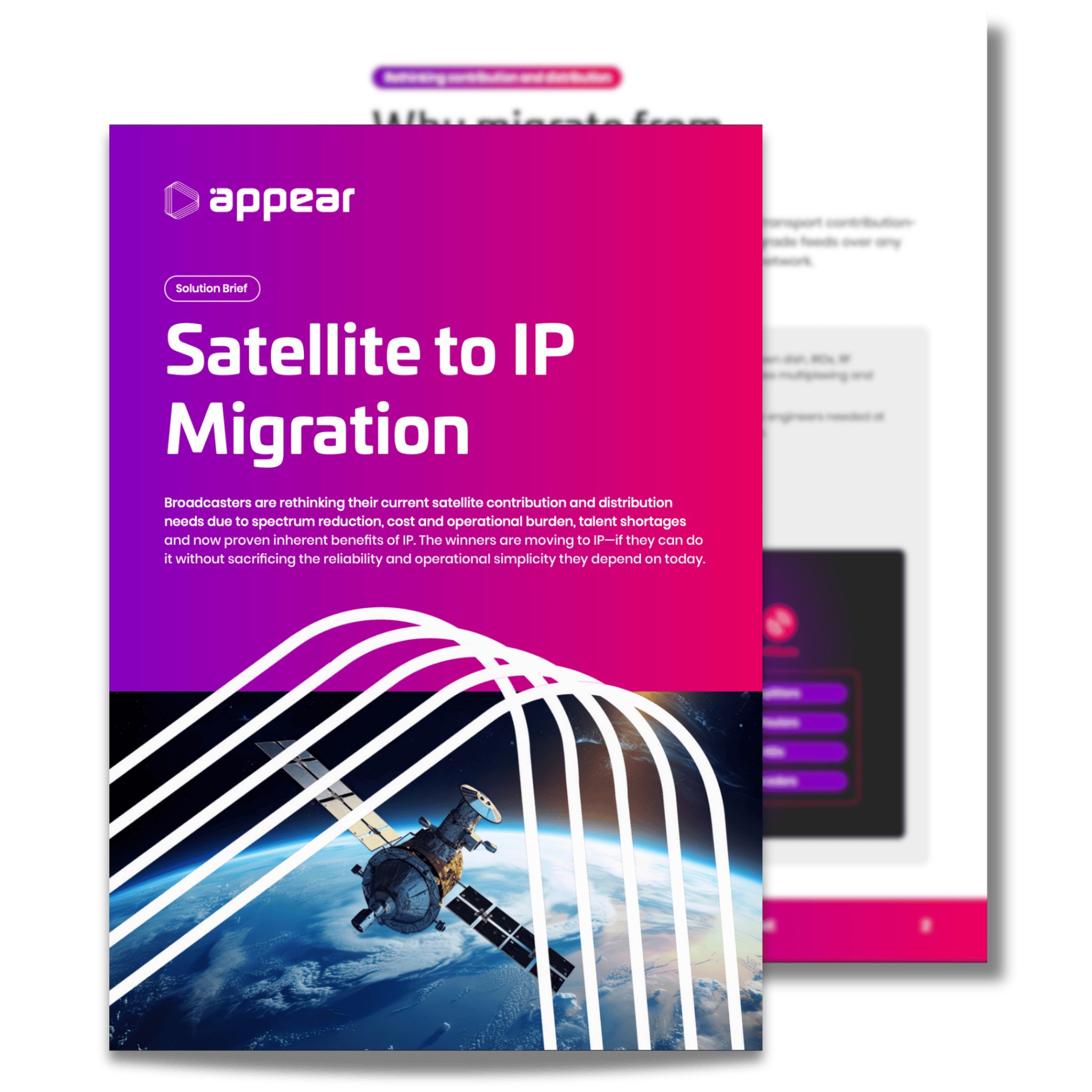
Plan your satellite to IP migration. A practical guide for broadcast and media teams moving contribution and distribution to IP.
Inside the guide:
- The key challenges of moving away from satellite
- What IP contribution and distribution makes possible
- Practical considerations for a smooth transition
Complete the form to download.
Key challenges, benefits, and practical considerations for a smooth transition from satellite contribution and distribution.
Download the guide