By Oliver Abadeer, Vice President Product Marketing
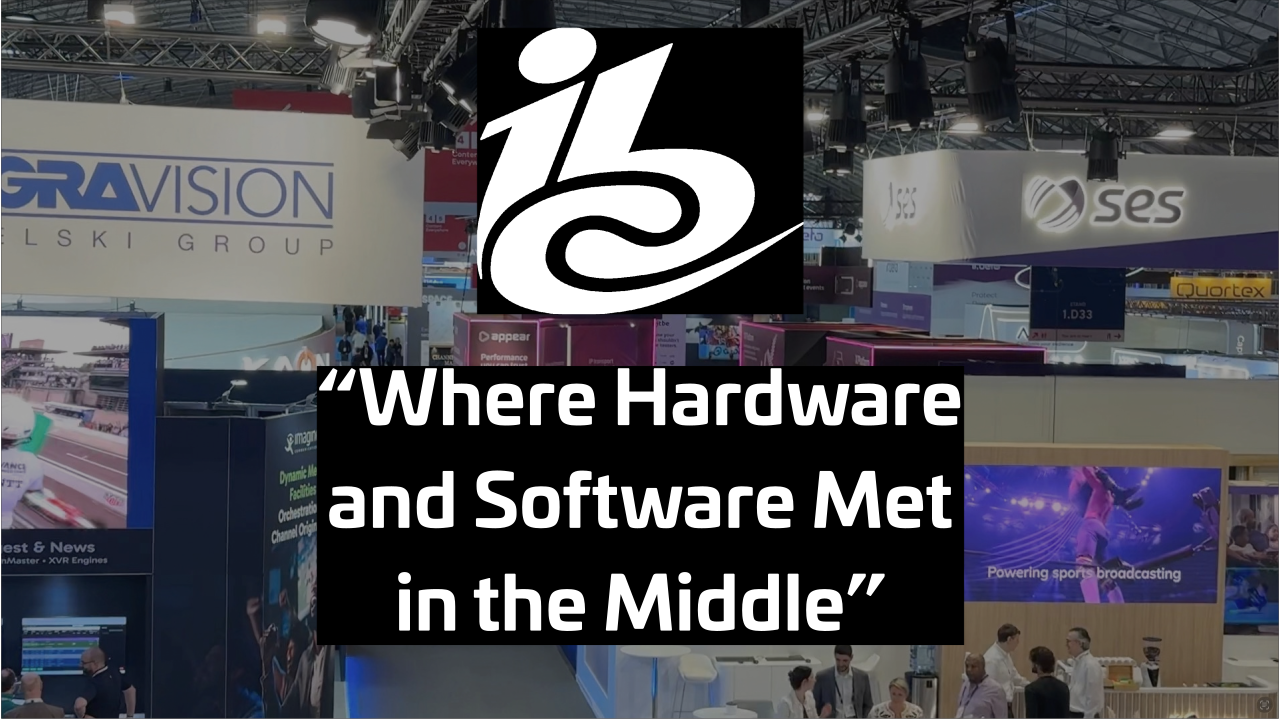
IBC 2026 spent four days arguing about a question we think is already settled: whether live production’s future is hardware or software. Walk the halls this year and the honest answer was neither, or rather, both—nearly every serious vendor on the show floor was demonstrating some version of hardware and software meeting in the middle. We didn’t find that surprising. It’s the architecture we’ve been building toward for two years, and this year we brought a full cycle of launches across X, VX, Hub, and XM to prove it out in production, not on a slide.
This is our read on the show: what we launched, what we saw, and why we think the hybrid argument is the right one to be having in 2027.
What we launched at IBC 2026
X Platform: the whole signal chain, denser and more secure. X5 now combines encode and decode across AVC, HEVC, and JPEG-XS, with a full audio stack including native Dolby Digital Plus with Atmos (JOC), IP redundancy, and genlock, in a single portable half-rack—two of which fit in 1RU. JPEG-XS is the headline addition: the lowest-latency contribution codec available, now in a box small enough for remote commentary and flypack work, not just the core. Alongside it, the new SIx300 module brings LUT-based HDR/SDR colour conversion inline into the X Platform signal path, on both SDI and ST 2110, so a facility converting formats doesn’t need a separate colour box in the chain.
The other headline from the X side is security. We demonstrated a live ST 2110 Trust Boundary on the stand, aligned to SMPTE RP2129—a hardware-enforced media firewall that separates customer-facing and private networks at the network edge, purpose-built for high-bitrate media traffic that a general-purpose IT firewall struggles to pass without introducing timing problems. That wasn’t a random feature to bring to this particular show: “can we trust the content” was one of the loudest themes on the floor this year, and we think a hardware trust boundary purpose-built for media, not adapted from enterprise IT, is the more durable answer to it.
VX Platform: from transport gateway to processing platform. The biggest structural addition is the Hybrid Cloud Gateway’s “Import from X”—VX now automatically discovers and imports SRT output configuration from connected X5, X10, and X20 units, with no manual IP configuration and no re-cabling. An existing X-series deployment keeps doing field contribution exactly as it does today; its outputs simply become VX inputs. That’s the detail that makes ground-to-cloud and hybrid REMI workflows practical rather than theoretical.
Around that sits a genuinely broader platform: VX now deploys across AWS, GCP, Azure, OCI, or private cloud, and natively ingests and delivers SRT, NDI, RTMP, WebRTC, and RTP (including ST 2022-7)—proven on the stand across AWS, Oracle Cloud, and Alibaba Cloud. A single VX ingest can distribute concurrently to social platforms over RTMP, production systems over NDI, and distribution partners over SRT, from one cloud workflow, so adding a new destination is a workflow step, not a new integration project. On the processing side, VX now decodes AVC and HEVC natively in software after an SPTS demux—sub-100ms target decode latency—so cloud or server-based decode no longer requires dedicated hardware. And ST 2022-7 seamless protection plus A/B failover now run as VX workflow steps on standard compute, meeting a resilience bar that used to require a dedicated hardware switch.
We also demonstrated VX MXL Out live at the show: media exchanged between two VX instances by sharing memory rather than passing it over the network, aligned to the Dynamic Media Facility architecture and the emerging Media eXchange Layer for microservice-based, software-defined production. And VX now deploys into enterprise, telco, and regulated environments with SSO via Azure AD and Okta, secrets and PKI management, and Grafana dashboards built in—the kind of security groundwork that decides whether a platform passes an IT-governance review at all, let alone how it performs once it’s through.
Hub and XM: the layer that makes a growing estate manageable. Appear Hub’s new Universal Search puts documentation, releases, release notes, and knowledge base behind one permission-aware search bar, and customer-specific software access replaces manual email and sFTP handovers with a controlled, auditable download experience. On the estate-management side, XM Profiles (GA in XM v1.1.0) let a team pull a proven configuration from any chassis, store it centrally as a single source of truth, and push it to any number of chassis across the estate—configure once, deploy everywhere, instead of rebuilding site by site. XM’s security and governance tools extend that same central control to firewall rules, media trust boundaries, and data-flow monitoring across every facility from one point.
What we launched, at a glance
| Platform | What’s new at IBC 2026 | Why it matters |
|---|---|---|
| X Platform | JPEG-XS contribution and native Dolby Atmos audio in a portable half-rack; SIx300 inline HDR/SDR conversion; a live ST 2110 Trust Boundary aligned to SMPTE RP2129 | The lowest-latency contribution codec now fits flypack and remote-commentary work; a hardware-enforced media firewall answers “can we trust the content” at the network edge |
| VX Platform | Zero-configuration “Import from X” from X5, X10, and X20; deployment across AWS, GCP, Azure, OCI, or private cloud; native software decode; ST 2022-7 failover on standard compute; a live VX MXL Out demo; enterprise SSO and security | Makes ground-to-cloud and hybrid REMI workflows practical rather than theoretical; removes the need for dedicated hardware to hit a resilience or decode-latency bar |
| Hub | Universal Search across documentation, releases, and the knowledge base; customer-specific software access | Replaces manual email and sFTP handovers with a controlled, auditable download experience |
| XM | XM Profiles (GA in v1.1.0) for centrally managed configuration; estate-wide security and governance tools | Configure once, deploy everywhere across a growing estate, instead of rebuilding site by site |
What we saw at IBC 2026
Set our own launches aside for a moment and look at what the rest of the show was doing. The pattern was hard to miss: interoperability stopped being a differentiator this year and became a checkbox. A majority of the vendors we tracked walked the floor demonstrating native or partner support for the Media eXchange Layer (MXL)—the Linux Foundation, EBU-backed open-source project for exchanging live media between software functions on shared compute. MXL itself was recognised as a finalist in this year’s IBC Innovation Awards, in the Content Creation category. That’s a meaningful signal on its own: an interoperability layer that was still being written into code a year ago is now mature enough to be judged as a finished piece of work.
We think that’s the right outcome, which is exactly why we demonstrated our own VX MXL Out live on the stand rather than waiting for the standard to fully settle. Interoperability between vendors’ software functions is good for the industry and good for customers, and we’d rather be part of defining it than reacting to it once it’s finished.
Security was the other theme that came up constantly, and not as an afterthought. “Can we trust the content” was a live question at IBC 2026, not a compliance checkbox—which is exactly the problem our ST 2110 Trust Boundary work and VX’s enterprise security additions were built to answer.
Timing was the theme nobody put on a keynote slide, but it came up everywhere once you started listening for it. The IBC 2026 Technical Papers programme included a paper from the UK’s National Physical Laboratory—the country’s official timekeeper—titled “Assured timing for broadcast: the invisible utility,” which is exactly the right description. Every IP media system depends on a single shared clock, distributed by PTP under SMPTE ST 2059, disciplining every device on the network so that video, audio, and ancillary data arriving over different paths at different latencies can still be aligned at the receiver. Most of the time nobody thinks about it, which is precisely the problem: that clock is usually anchored to GNSS, and GNSS signals are weak enough that jamming and spoofing are now a real resilience question, not a hypothetical one. More than one vendor on the floor was showing dedicated hybrid SDI/IP sync generators built specifically to hold a stable clock through a GNSS outage on local oscillator holdover—a sign this isn’t a solved problem so much as a live product category.
Software-defined production makes the timing problem harder, not easier, and we think that’s under-discussed relative to how much attention interoperability gets. A single facility with one PTP grandmaster is a comparatively easy timing domain. A workflow spread across cloud regions, containers, and 5G contribution links is not—path asymmetry and jitter on a wireless or public-internet hop erode the precision PTP is built to guarantee, and a microservice architecture has to carry timing discipline as a first-class design problem, indexing media against the PTP epoch, rather than assume it away. If “can we trust the content” was one loud theme this year, “can we trust the clock everything else depends on” was the quieter one sitting right underneath it.
But here’s where we think the show’s framing missed something. Nearly every vendor talking about interoperability this year was making a software argument: how software functions exchange media with each other. Almost none of them were making the harder argument, which is what happens when half your estate is still, correctly, hardware. Live production isn’t moving wholesale to software, and it shouldn’t—deterministic, appliance-grade hardware still does the job at the edge and in the core better than anything running on commodity compute. The interesting question isn’t “hardware or software,” it’s how you run both under one operational model without doubling your vendor list, your training burden, or your support contracts. That’s a smaller, less crowded conversation than the interoperability one, and it’s the one we think actually matters for anyone running a live production estate at scale.
Hardware and software, one operating model
X Platform (hardware)
- Deployment: dedicated appliance, on-premises or in the field
- Determinism: appliance-grade, deterministic performance at the edge and in the core
- Best suited to: mission-critical contribution and processing where timing and security can’t be assumed away
VX (software)
- Deployment: cloud (AWS, GCP, Azure, OCI) or private cloud, virtualised or edge
- Determinism: software-defined, extending X’s functions, formats, and control plane into flexible environments
- Best suited to: ground-to-cloud, hybrid REMI, and multi-destination workflows that need to scale or move quickly
What this means going into 2027
IBC 2026 confirmed that the industry is converging on open, software-defined media exchange, and we think that’s genuinely good news—it validates a bet on interoperability we made before it was the consensus position. But interoperability between software functions solves one part of a live production estate, not all of it. The part that’s harder, and the part we’re built for, is running hardware and software as one operating model instead of two. That’s the argument we came to IBC 2026 to make, and it’s the one we expect to be making through 2027.
Frequently asked questions
What did Appear launch at IBC 2026? Across X, VX, Hub, and XM: on X5, JPEG-XS contribution with native Dolby Digital Plus/Atmos support in a portable half-rack, inline HDR/SDR conversion via the SIx300 module, and a live-demonstrated ST 2110 Trust Boundary aligned to SMPTE RP2129. On VX, a zero-configuration “Import from X” bridge from existing X-series hardware, cloud- and protocol-agnostic deployment across SRT, NDI, RTMP, and WebRTC, native software decode, hitless ST 2022-7 failover, live MXL interoperability, and enterprise SSO/security. On Hub, Universal Search and customer-specific software access. On XM, centrally managed configuration profiles and estate-wide security governance.
What is Appear’s position on MXL and DMF interoperability? We demonstrated VX MXL Out live at IBC 2026—media exchanged between VX instances by sharing memory—and we’re continuing to build toward the Dynamic Media Facility architecture. We see open interoperability between software media functions as good for the industry, and one part of a bigger problem: running hardware and software together as one estate, not the whole answer on its own.
What’s the difference between X and VX? X is Appear’s deterministic hardware platform for live production; VX is the software-defined counterpart, built on the same functions, formats, and control plane. VX extends X into cloud, virtualised, and edge deployments—including a direct, auto-discovered bridge from existing X-series hardware—rather than replacing it.
Is Appear moving away from hardware toward software? No. We think the industry’s hardware-versus-software framing is the wrong question. Live production still needs deterministic, appliance-grade hardware at the edge and in the core; the real problem worth solving is running hardware and software under one operational model, which is what X and VX are built to do together.
Why does timing and synchronisation matter for software-defined production? Every IP media system depends on a single shared clock, distributed by PTP (SMPTE ST 2059), so that streams travelling different paths at different latencies can still be aligned at the receiver. That clock is usually anchored to GNSS, which is vulnerable to jamming and spoofing, and it gets harder to hold as production spreads across cloud, containers, and 5G contribution links. We think timing discipline has to be designed into a hybrid architecture from the start—genlock and IP redundancy on the hardware side, a shared PTP reference carried through the trust boundary between networks—rather than assumed away as a software detail.
Get the brief
One REMI workflow, every event. A solution brief for broadcast and media teams building remote production at scale.
Inside the brief:
- Low-latency contribution across managed and unmanaged networks
- Building resilience into remote production workflows
- Reducing on-site infrastructure per event
Complete the form to download.
How to deliver low-latency, resilient contribution across managed and unmanaged networks—while reducing on-site infrastructure.
Download the brief